When I arrived at G Hotel by Waterfront, I realized that the orange sun was about to set!
I was confused... should I leave all my bags in the room before running to the Baywalk area of the Roxas Boulevard, or should I go directly to watch the Manila Bay sunset?
I was bringing many little bags which turned out quite bulky... so I run first to the room to leave my things.
I remembered the place I went to, to get a beautiful view of the Roxas Boulevard...and that was at the Promenade Hall of G Hotel at the Seventh Floor!
The place was closed but I went in anyway (pardon me!) and found my way to the balcony!
YES! I was just in time....
The Roxas Boulevard, previously known as Dewey Boulevard is an eight-lane highway in the heart of Manila and viewing the Manila Bay.
From: http://en.wikipedia.org/wiki/Roxas_Boulevard
Roxas Boulevard (formerly known as Dewey Boulevard) is a boulevard in Metro Manila, and an eight-lane arterial road that connects the center of Manilawith Pasay City, Parañaque City. It is one of the major arteries in the city's metropolitan network, designated as Radial Road 1. Formerly named in honor of the American Admiral George Dewey who defeated the Spanish navy in the Battle of Manila Bay in 1898, the boulevard was renamed to Roxas Boulevard in the 1960's to honor President Manuel Roxas, the fifth President of the Republic of Philippines. Roxas Boulevard runs along the shores Manila Bay and is well-known for its sunsets. The boulevard has become a trademark of Philippine tourism, famed for its yacht club, hotels, fine dining restaurants and parks. The arcing road runs in a north-south direction from Luneta in Manila and ends in Parañaque City, at the intersection of Ninoy Aquino International Airport Road or NAIA Rd.[3] Beyond its southern terminus, starts the Manila-Cavite Expressway or Coastal Road.
Manila Bay is known for its beautiful sunset and the Roxas Boulevard is a good place to view it.
Many times, other places with boulevards like Dumaguete City and Zamboanga City compare their boulevards with the Roxas Boulevard, and they also view interesting sunsets there.
from: http://en.wikipedia.org/wiki/Manila_Bay
Manila Bay is a natural harbor which serves the Port of Manila (on Luzon), in the Philippines.
The bay is considered to be one of the best natural harbors in Southeast Asia and one of the finest in the world. Strategically located around the capital city of the Philippines, Manila Bay facilitated commerce and trade between the Philippines and its neighbouring countries[1], becoming the gateway for socio-economic development even prior to Spanish occupation. With an area of 1,994 km2 (769.9 sq mi), and a coastline of 190 km (118.1 mi), Manila Bay is situated in the western part of Luzon and is bounded by Cavite and Metro Manila on the east, Bulacan and Pampanga on the north, and Bataan on the west and northwest.[2] Manila Bay drains approximately 17,000 km2 (6,563.7 sq mi) ofwatershed area, with the Pampanga River contributing about 49% of the freshwater influx. With an average depth of 17 m (55.8 ft), it is estimated to have a total volume of 28.9 billion cubic meters (28.9 cubic km). Entrance to the bay is 19 km (11.8 mi) wide and expands to a width of 48 km (29.8 mi). However, width of the bay varies from 22 km (13.7 mi) at its mouth and expanding to 60 km (37.3 mi) at its widest point.[2]
The Manila Bay sunset is a photographer's dream and I, too, was amazed by the "orangey" sunset.
** zoom


 |
| late afternoon at Roxas Boulevard facing the Marina and Sofitel |
 |
| one of the sidewalks at the Baywalk of the Manila Bay at dusk |
From: http://en.wikipedia.org/wiki/Roxas_Boulevard
Roxas Boulevard (formerly known as Dewey Boulevard) is a boulevard in Metro Manila, and an eight-lane arterial road that connects the center of Manilawith Pasay City, Parañaque City. It is one of the major arteries in the city's metropolitan network, designated as Radial Road 1. Formerly named in honor of the American Admiral George Dewey who defeated the Spanish navy in the Battle of Manila Bay in 1898, the boulevard was renamed to Roxas Boulevard in the 1960's to honor President Manuel Roxas, the fifth President of the Republic of Philippines. Roxas Boulevard runs along the shores Manila Bay and is well-known for its sunsets. The boulevard has become a trademark of Philippine tourism, famed for its yacht club, hotels, fine dining restaurants and parks. The arcing road runs in a north-south direction from Luneta in Manila and ends in Parañaque City, at the intersection of Ninoy Aquino International Airport Road or NAIA Rd.[3] Beyond its southern terminus, starts the Manila-Cavite Expressway or Coastal Road.
Manila Bay is known for its beautiful sunset and the Roxas Boulevard is a good place to view it.
Many times, other places with boulevards like Dumaguete City and Zamboanga City compare their boulevards with the Roxas Boulevard, and they also view interesting sunsets there.
from: http://en.wikipedia.org/wiki/Manila_Bay
Manila Bay is a natural harbor which serves the Port of Manila (on Luzon), in the Philippines.
The bay is considered to be one of the best natural harbors in Southeast Asia and one of the finest in the world. Strategically located around the capital city of the Philippines, Manila Bay facilitated commerce and trade between the Philippines and its neighbouring countries[1], becoming the gateway for socio-economic development even prior to Spanish occupation. With an area of 1,994 km2 (769.9 sq mi), and a coastline of 190 km (118.1 mi), Manila Bay is situated in the western part of Luzon and is bounded by Cavite and Metro Manila on the east, Bulacan and Pampanga on the north, and Bataan on the west and northwest.[2] Manila Bay drains approximately 17,000 km2 (6,563.7 sq mi) ofwatershed area, with the Pampanga River contributing about 49% of the freshwater influx. With an average depth of 17 m (55.8 ft), it is estimated to have a total volume of 28.9 billion cubic meters (28.9 cubic km). Entrance to the bay is 19 km (11.8 mi) wide and expands to a width of 48 km (29.8 mi). However, width of the bay varies from 22 km (13.7 mi) at its mouth and expanding to 60 km (37.3 mi) at its widest point.[2]
The Manila Bay sunset is a photographer's dream and I, too, was amazed by the "orangey" sunset.
Then, another question popped in my head... Is this a sunset scene or a dusk scene? These terms are noted in point-and-shoot cameras.
So, I looked up Sunset and Dusk from the Wikipedia and also found a new word, Evening Twilight.
Sunset or sundown is the daily disappearance of the Sun below the horizon in the west as a result of Earth's rotation.
The time of sunset is defined in astronomy as the moment the trailing edge of the Sun's disk disappears below the horizon in the west. The ray path of light from the setting Sun is highly distorted near the horizon because of atmospheric refraction, making sunset appear to occur when the Sun’s disk is already about one diameter below the horizon. Sunset is distinct from dusk, which is the moment at which darkness falls, which occurs when the Sun is approximately eighteen degrees below the horizon. The period between sunset and dusk is called twilight.
Dusk is the beginning of darkness in the evening, and occurs after twilight, when the sky generally remains bright and blue. Civil dusk is when the earth has rotated enough that the center of the sun is at 6° below the local horizon. This marks the end of the evening civil twilight, the point where artificial illumination is required to read outside.[1] It can be confused with sunset, which is the point at which the earth has rotated enough, that the sun is no longer visible from the local horizon.
So it starts with Sunset then Evening twilight then Dusk.
I specifically mentioned Evening twilight because there is also a Morning twilight between Dawn and Sunrise.
I specifically mentioned Evening twilight because there is also a Morning twilight between Dawn and Sunrise.
And we thought Twilight was just a blockbuster movie!
The photos are not exactly of premium quality since I just used the Nikon Coolpix P500 36x superzoom and not the Nikon D90 DSLR.
I didn't bring the DSLR because I thought it was a Convention I was attending and no special occasion for photography.
But, I would still like to share it anyway.
By the way, no Photoshop here, just a little bit of tweaking from iPhoto...
SUNSET
The time of sunset is defined in astronomy as the moment the trailing edge of the Sun's disk disappears below the horizon in the west.
When I arrived at the Seventh Floor, I was sad to see heavy clouds covering the brilliant vermillion sunset!
But, eventually, the sunset was visible again.
** wide
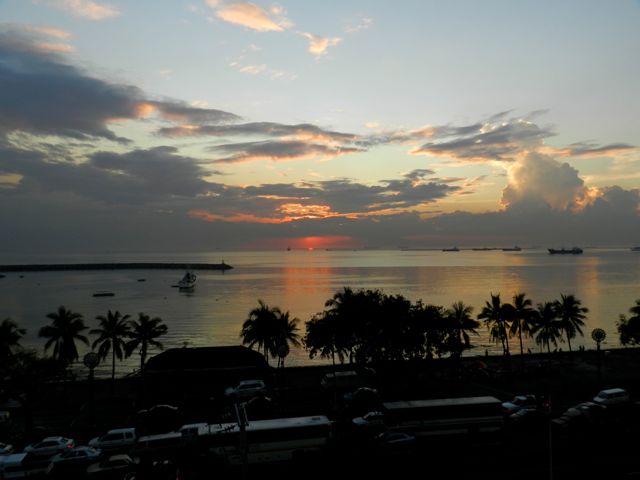 |
| View of the sunset faraway |
 |
| sun was still covered by the dark clouds |
 |
| the sun is now seen again |
 |
| as sun peeks from the clouds |
 |
| more visible sun coming out from covering cloud |
 |
| sunset |

 |
| as it goes down behind the mountain |

 |
| sun sets behind the mountain |
EVENING TWILIGHT
The period between sunset and dusk is called twilight.
Evening civil twilight is the point where artificial illumination is required to read outside.
** wide
 |
| sun has set and no longer visible |
 |
| Roxas Boulevard facing Manila Hotel and the Manila Ocean Park |
** midzoom

DUSK
Dusk is the beginning of darkness in the evening, and occurs after twilight, when the sky generally remains bright and blue. Civil dusk is when the earth has rotated enough that the center of the sun is at 6° below the local horizon. This marks the end of the evening civil twilight, the point where artificial illumination is required to read outside.
** wide
 |
| the blue color of dusk |
 |
| sky is starting to be blue and the Baywalk lights are now lighted up. |
** midzoom
 |
| at dusk, the sun has set and the sky acquires a blue hue and the lights of the Baywalk are now open |
Seems like a Science Class instead of an Art Appreciation blog, right?
Anyway, there will be more beautiful sunsets in Manila Bay than the ones I got, but I am happy I was able to experience it just the same.


