Showing posts with label Yellow Boat of Hope. Show all posts

Saturday, February 9, 2013

LAYAG-LAYAG YELLOW BOAT VILLAGE: BUSINESS

One of our observations in the Layag-Layag Yellow Boat Community is that we notice presence of trade within.

I would just like to share these images with you...

They also have sari-sari stores in the village. I saw two of them.
This is the bigger store...
their convenience store with soft drinks and many other needs...
The other store...

see what are needed in the community...
They now have the buying capacity... 

There are also visiting stores selling fruits...
Photo Credit: Doc Anton Lim 
Photo Credit: Doc Anton Lim


We hope their own livelihood will really prosper.
They shared that they really hope for a good seaweed harvest.

What do they really spend for?

They need the income for the schooling of the children in Talon-Talon... by the way, even public schools are not free!
They also buy fish, chicken, beef at the Public Market in Talon-Talon and do some shopping at malls in Zamboanga City.
I even kiddingly said. "No wonder you are also wearing jerseys!" and he laughed.
The stores within the village are also for immediate needs and some things they may actually fancy.
They also said, that they keep a part for savings.

It is very interesting to see this activity within the Layag-Layag Village.
Though, not the usual village we know, we can see their needs and wants somehow also may be similar to ours!


LAYAG-LAYAG YELLOW BOAT VILLAGE: CHILDREN

As we were in awe with our experience at the Layag-Layag Village, I guess what caught our attention were the kids who have beautiful smiles.

According to Doc Anton, in the early years, the children were very wary and afraid of visitors coming over to their village but through the few years, the kids have become more spontaneous.

As we were approaching the village, we saw these kids playing at the sand bar...

If I didn't see the kids play, I would have thought that since we were in the open sea and the waves were quite visible, I would think this place wasn't too safe.

Here are the kids in the nearby water village ...
I guess, this is really the life they are used to.

As we arrived, we saw this little girl walking around...


Yes, no rubber boots... I do hope she had slippers but I wasn't able to check that out.
We realized... yes! we, too were jumping into the water and walk around the water. 
The villagers look at us with curiousity... and with smiles...

And yes, I saw them throw the lanzones peel and seeds to the water... but even then, the water does not look dirty.
I see the kid from the boat without any slippers. The kids already know how to row the boats from one house to the other...
Photo credit: Doc Anton Lim

In fact, the boys who bring us to their villages also live in the village!

As we went further on, the water was more shallow but the ground was really rocky and we were even warned to be careful because the edges were sharp!
The kids went to this place to play the kite, which they call "taguri". I guess, this was a very nice place to play with a kite (sans the rocks!) because one had all the space and the fresh wind!
But, I noticed they really did not wear slippers inspite of the rocks.

Didn't really hear them complain about illnesses...
nor see illness in their aura!
under the house
And, they love the kite!

Also, in this area is the mosque...
photo credit: Doc Anton Lim
Although, the older kids go to school, they also help out while they are at home.
Patricia, 16 and Annalisa, 14 help out their mother, Putli with the seaweeds..
Here is a young girl, who was watching us closely while she was taking care of a baby.
The younger kids have to be independent and actually, we only saw a few adults around.

The Tzu-chi and the Yellow Boat of Hope Community also provided the Day Care Center for the younger kids. The limitation, sometimes, is the availability of teachers who are willing to go to these difficult places.
Life goes on for these kids!
They appreciate life as it is...
They are happy with simple joys...
the "taguri"... the sandbar... 
the people around them!

We wish we could give them
a better life as we know it...
but, they may actually have a better one!
They seem resistant to illness...
I hope they are!

So yes, let us just share...
For improvement of their livelihood...
For their opportunity to good education...
For disease prevention...
And access to healthcare!

May these kids be our inspiration
To just be happy with simple things...
To accept what life has to offer...
To make the most of what is available...
To appreciate life to the fullest!!!

☺☺☺

Thursday, February 7, 2013

LAYAG-LAYAG YELLOW BOAT VILLAGE: HOUSES

Again, I want to share about another theme: the houses in the Layag-Layag Mangrove Village.
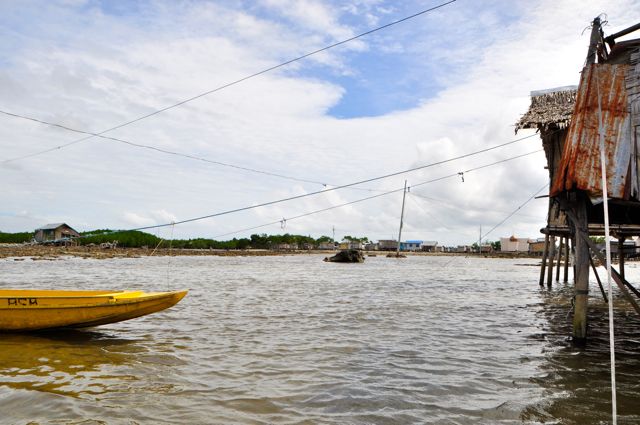
This is one of the floating villages we passed by before we reached the community we visited. Indeed, these are houses on stilts.


And here are the houses at the village:
 

photo credit: Doc Anton Lim

And sometimes, houses are connected to each other by bamboo poles.


Do you notice the ropes?
These are the ropes to stabilize the houses.


And these are the tires to where the ropes are attached.
Abs confirmed that they really stay in the houses while there are typhoons!

This is the undersurface of the house.


And here is an example of a weather-beaten house!... Can you imagine if this is the effect of the typhoon?
Photo Credit: Michelle Lim


And this is the community further on, already partly on land... 
Mosque from afar


We have witnessed how they live in this village... and definitely, it is not easy.
We know how we complain of floods, but here, they actually live it!
But as they say, the Tausug are sea people and literally "Tao" means people and "sug" means (sea) current, therefore, "People of the Sea Current"!
Their life revolves around these stilt houses and the seaweed farms but still they need to go to the mainland to sell their seaweeds and where they get their other needs such as marketing, shopping and schooling!
Gangnam style by the Travel Reportage group
Photo Credit: Doc Anton Lim


Monday, February 4, 2013

LAYAG-LAYAG YELLOW BOAT VILLAGE: SEAWEEDS


A friend of mine asked me, "Why do they continue to live in stilt houses? Couldn't they live in solid grounds?"

I asked for Doc Anton's help and he  answered: "The Tausug are sea people. Culturally, they are more at ease in water. But are also informal settlers who don't have the means to own property inland. Their main livelihood are fishing and seaweed farming that necessitates them to live near the shoreline."

So I'd like to share on images of Seaweed Farming and Agar-Agar!

The Philippines is considered the  world’s  leading supplier of Eucheuma, comprising about 80% of the total world supply (SIAP, 1996).  In 1990, the country’s total seaweed farm production reached a high of about 400,000 metric tons of fresh Eucheuma seaweeds planted by about 80,000 seaweed farmers/ families. Today, seaweed production and processing have become a high value and profitable livelihood activity in many marginal seafarming communities as well as profitable enterprises in urban centers of the country.  

It is of great demand in the global market due to its diversified uses of carrageenan, which is used as stabilizer, gelling agent, thickener, binder and additive for  various dairy products, cosmetics, pet food, meat processing and beer bottling industries.  Seaweed farming also requires less capital than any other aquaculture species, not labor-intensive and does not need inputs that are potentially harmful to the environment.


The seaweed farms are practically out in the open sea. We passed by these farms on the way to the Layag-Layag Village.
This picture may not be photographically perfect but I would like to show you the expanse of the sea... the paradise of the sea people... their source of work... their life!

The seaweed farm: The sea is dotted by plastic bottles. Oh no! These are not garbage!!!
Here, they are used as buoys and underneath these bottles are the seaweeds, waiting to grow!

Floating Monoline Method 
The floating monoline method has the following advantages over  the fixed, bottom monoline method: a) grazing by bottom-associated animals is minimized or eliminated because the plants are raised out of reach of benthic grazers b) plants near the surface of the water column are exposed to more moderate water movement caused by waves. 


The seaweed farmers:

The seaweeds are harvested:
Harvest after 2-3 months. Take the  whole plants but leave enough for the replanting of new cuttings.  

The seaweeds are brought to the houses:

This is the Eucheuma spp.
The seaweeds are tied into bundles. 
Four bundles would weight about a kilo!
A kilo of seaweeds could be sold for P4.00 OR P1.00 per bundle!
But they could have a thousand kilos or ten thousand kilos of seaweeds per one to two months depending on the weather and other natural factors.


*About 6 kg fresh seaweed  is needed to produce 1.0 kg of dried seaweed with dry weight at 30-40% moisture content (MC). 
**Initial 40,000 pcs. seedlings at 200 grams each will grow to 1,000 grams each after 45 days.

I asked,"What do you spend for?" 
One answered, they buy food from the public market. 
I really thought they just caught fish for their dinners. But, not so...they also ate chicken, sardines, too!
Another answered, we buy clothes from Shoppers'. One even wore the jersey jacket.
Another said, we pay for education like at the Talon-Talon Elementary School!
And, they also try to save about a fourth of the earnings... for a "rainy day"!

Next, the other seaweeds are also tied and ready for the next farming cycle.

The seaweeds are placed in net sacks!

Seedling Bed 
Construct a 5m x 10mx 2 m cage-type seedling bed. Place seedstocks on it before planting. Immerse  it in seawater to prevent from undue stress. 
Seedstock should be planted after a week of stocking. 

I guess, below is their version of the seedling bed!


The prepared seaweeds are then sold to the mainland and there, post-harvest techniques are done.
The seaweeds are dried and salt is placed all over the seaweeds.

DRYING 
Spread the harvested seaweeds evenly on a bamboo platform. Remove other species of algae, “tie-tie” or other extraneous materials like rocks, sands and others. Never dry the seaweed directly on sand to avoid contamination. In the absence of a drying platform, use coconut palms as flooring. 

During sunny days, turn over the seaweeds regularly within two to three days and four to five days when cloudy. When properly dried, Eucheuma has a  rubbery touch [30% moisture]. 

Pack dried materials in plastic sacks and store in a dry  and well-ventilated place. 


The dried seaweeds would now cost about P38.00 / kilo.
Remove other species of algae, “tie-tie” or other extraneous materials like rocks, sands and others.


We now understand a bit, why they would want to continue to live there throughout the year.
This is where they live their lives... their livelihood... and yes, they say continue to stay on even when there are typhoons!